By Dr. Steve Tieche, Medical Director and Co-Founder of Recharge Clinic
Patients often walk into my office with a thyroid result highlighted on their phone.
“It says normal and my other doctor said it is normal. So why don’t I feel good?”
That is a fair question.
But it has two possible traps: assuming that one result inside a reference range ends the conversation, or assuming that every case of fatigue, weight gain, brain fog or hair loss must be a hidden thyroid problem.
A thyroid panel is not a report card with one passing or failing grade. Each test answers a different question. Good thyroid care means knowing which question we are asking, choosing the right tests and interpreting the results alongside the patient’s symptoms, history, medications and overall health.
We have already explained the difference between hypothyroidism and Hashimoto’s. This article goes one step deeper: what do the common thyroid tests actually tell us?
TSH stands for thyroid-stimulating hormone. It is made by the pituitary gland—not the thyroid. Yes, that is what I said. So for those out there that have providers who are only checking your thyroid based off of TSH… Someone please let them know.
Think of TSH as an instruction. When the body needs more thyroid hormone, the pituitary generally sends more TSH to push the thyroid harder. That is why TSH is an excellent first screening test and often rises in primary hypothyroidism.
But TSH is still a signal. It is not the thyroid hormone your cells use, and it does not answer every thyroid question by itself.
TSH is something to look at, but not the only lab to check.
T4, or thyroxine, is the main hormone produced and released by the thyroid. Think of it as the reserve form. A Free T4 test estimates the portion not bound to carrier proteins and available to tissues.
Here is one important clarification: there needs to be a conversion from T4 into T3. We covered that process more fully in Still Feeling Terrible on Thyroid Medication? Here’s What Most Patients Are Never Told, so I will not repeat the whole explanation here.
TSH and Free T4 are especially useful when read together:
T3, or triiodothyronine, is the more active thyroid hormone. It is the part of the conversation patients often miss when they are told that their TSH alone is “fine.” Free T3 can add useful information when we interpret it beside TSH and Free T4, especially when evaluating hyperthyroidism, an unusual lab pattern or someone taking medication that contains T3.
But this needs to be said clearly: Free T3 is not a perfect stand-alone test for diagnosing routine hypothyroidism. T3 can remain within range even when a patient is hypothyroid, and illness, calorie restriction, medications and the testing method can affect the result.
At Recharge Clinic, Free T3 is part of the initial panel we order for new thyroid patients. That does not mean every person needs it repeated at every visit or that a Free T3 result should be treated in isolation. It means we prefer to see the basic pattern together from the beginning instead of discovering later that an important piece was never checked.
Thyroid peroxidase antibodies, or TPO antibodies, and thyroglobulin antibodies, or TgAb, can identify thyroid autoimmunity. A person may have Hashimoto’s while TSH and Free T4 are still within range because the immune process and loss of thyroid function do not always happen at the same speed.
Some patients have elevated TPO antibodies. Some have TgAb. Some have both. Others with a convincing history or thyroid changes do not show a dramatic antibody elevation on a single test. That is one reason we do not diagnose or dismiss an entire person from one isolated marker.
Antibodies may help explain why thyroid dysfunction is developing. They do not, by themselves, tell us how much thyroid hormone the body needs or whether medication should start that day.
We do not “chase” an antibody number and ignore everything else. We assess thyroid function, symptoms, trends and the patient’s overall clinical picture.
A laboratory report makes it easy to spot an H, an L or a result sitting somewhere inside the printed range. That is not the same thing as understanding thyroid physiology, and it is definitely not a treatment plan.
One of the biggest disconnects we see is not getting the numbers. It is knowing what to do with them.
How do TSH, Free T4 and Free T3 fit together? Is TSH rising as Free T4 falls? Is medication timing changing the picture? Do TPO antibodies point to an autoimmune cause? Does the current result match the patient’s prior trend, symptoms and medical history? Could pregnancy, pituitary disease, illness, supplements or another medication be affecting the result?
Anyone can read the reference range printed beside a lab value. The training and experience matter when the numbers do not tell a simple story. Good thyroid care means knowing which patterns are meaningful, when a result may be misleading, what should be repeated, what should not be chased and how to adjust treatment safely when treatment is actually needed.
We treat the patient using the labs. We do not treat the lab report as if the patient is not attached to it.
Reverse T3 is produced when T4 is converted into an inactive form rather than active T3. Levels may change during severe illness, major calorie restriction and significant physiological stress.
That biological fact has sometimes been stretched into claims the evidence does not support. Reverse T3 is not established as a routine test for diagnosing hypothyroidism or deciding that someone needs T3 medication. A test can measure something real and still have limited clinical value.
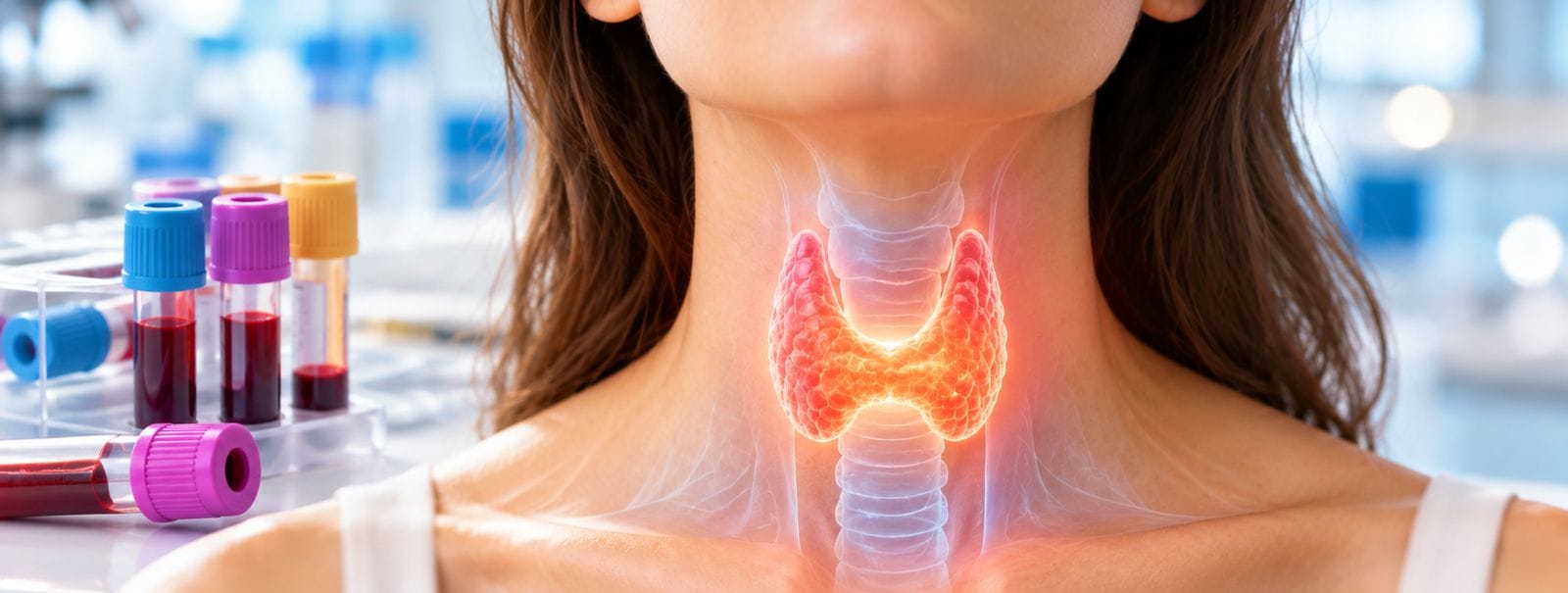
Blood tests tell us how the thyroid system is functioning. Ultrasound shows us what the gland looks like. It may be appropriate for a lump, enlargement, neck pressure or nodule, but it does not measure thyroid hormone production.
A normal ultrasound does not guarantee normal thyroid function, and an abnormal ultrasound does not automatically mean a person needs thyroid medication.
This is where real clinical work begins.
Fatigue, hair shedding, brain fog, constipation, difficulty losing weight, mood changes and poor sleep can occur with thyroid disease. They can also occur with iron deficiency, low vitamin B12, perimenopause, low testosterone, insulin resistance, sleep apnea, medication effects, chronic stress and many other conditions.
We discussed that overlap in Is It Your Thyroid, Your Hormones, or Just Burnout?.
The answer is not to ignore symptoms because TSH is normal or to keep adding thyroid medication when thyroid function is normal. The answer is to investigate intelligently.
Depending on the history, that may include reviewing medication timing and absorption, repeating an unexpected result, checking additional thyroid markers or evaluating iron, nutrients, blood sugar, hormones, sleep and other likely causes.
We listen to the patient, but we do not ignore what is happening inside the body.
At Recharge Clinic, our standard starting panel for every new thyroid patient includes TSH, Free T4, Free T3 and TPO antibodies.
We would rather collect those four pieces at the first visit than order TSH alone, bring the patient back and then discover that we need another blood draw and another visit to answer the next obvious question. These are not exotic tests. Looking at them together from the beginning can save the patient time, repeat testing and money in the long run.
That does not mean we order every specialty thyroid test for every patient, and it does not mean every value gets its own prescription. It means we start with enough information to understand the basic pattern. Then we ask what changed, review prior results, consider medication timing and decide whether the labs and real life are telling the same story.
Sometimes the thyroid is the answer. Sometimes it is one part of the answer. Sometimes it is functioning normally, and the patient still deserves help finding the real cause of the symptoms.
That is not dismissing the patient. That is practicing medicine.
Your results deserve an explanation—and your symptoms deserve attention. If you’re still feeling tired, foggy or unlike yourself, let’s take a closer look. At Recharge Clinic, we review your symptoms, history and lab results together to help you understand what they mean and what comes next. Schedule your thyroid evaluation at our Ocala, Lady Lake/The Villages or Clermont locations, with telehealth available throughout Florida when appropriate. Call 352-512-9996 or request an appointment.
TSH is the standard initial screening test for most people, but screening is not the same as a complete new-patient thyroid evaluation. At Recharge Clinic, our starting panel for a new thyroid patient includes TSH, Free T4, Free T3 and TPO antibodies so we can interpret the basic pattern together. Other testing may be appropriate depending on symptoms, medication use, pregnancy status, medical history and the clinical question being asked.
Yes. Thyroid antibodies or other evidence of autoimmunity may be present before the thyroid loses enough function to raise TSH or lower Free T4. That does not automatically mean medication is necessary, but ongoing monitoring may be appropriate.
At Recharge Clinic, Free T3 is part of the initial panel for new thyroid patients, but it is not a reliable stand-alone test for routine hypothyroidism and may not need to be repeated at every visit. Reverse T3 is different: it does not have an established role in routine diagnosis or medication adjustment for most thyroid patients, so we use it selectively rather than automatically.
Yes. Biotin, which is common in hair, skin and nail supplements, can interfere with certain thyroid assays. Tell your provider about every medication and supplement you take, and follow the provider’s or laboratory’s instructions before testing.
Recharge Clinic offers thyroid evaluations and in-house laboratory testing at our Ocala, Lady Lake—serving The Villages—and Clermont locations. Telehealth follow-up may also be available throughout Florida when clinically appropriate. Call 352-512-9996 or contact Recharge Clinic to get started.
Thyroid testing is not about finding one magical number.
TSH is valuable. Free T4 is valuable. Free T3, antibodies and imaging can be valuable in the right situation.
But a lab result should never be interpreted without the patient attached to it.
You deserve more than “normal” or “abnormal.” You deserve an explanation of what was tested, what it means and what the next reasonable step should be.
If you are a medical provider reading this to learn more about thyroid treatment, please understand that this blog is not clinical training. It is a simplified overview written for nonmedical readers—not a guide for diagnosing, prescribing or managing patients. I offer one-on-one clinical training for providers who want to learn how to apply this information safely and appropriately in practice.
If you are a patient struggling with thyroid symptoms, please do not use this blog—or information found online—to diagnose or treat yourself. Thyroid care should be individualized and guided by a qualified medical provider who can evaluate your symptoms, medical history and laboratory results.

Monday: 8:00 am - 6:00 pm
Tuesday - Wednesday: 8:00 am - 5:30 pm
Thursday: 8:30 am - 6:30 pm
Friday: 8:00 am - 6:00 pm
Saturday: 7:45 am - 1:00 pm
After-hours appointments can be made.
Walk-ins are welcome.
Monday - Friday: 8:30 am - 5:30 pm
Walk-ins are welcome.
Monday - Friday: 8:30 am - 5:30 pm
Walk-ins are welcome.
Monday - Friday: 8:30 am-5:30 pm
Walk-ins are welcome.
Monday: 8:30 am - 5:30 pm
Tuesday: Telehealth Appts. Only
Wednesday - Friday: 8:30 am - 5:30 pm
Saturday & Sunday: Closed
Walk-ins Welcome
Monday - Wednesday 8 am - 6 pm
Thursday 8 am - 6:30 pm
Friday 8 am - 6 pm
Saturday 7:45 am - 1 pm
👻BOTOX & BOOs👻
OCTOBER 23
8:30 AM - 5:30 PM
3175 Citrus Tower Blvd, Bldg 3,
Ste B, Clermont, FL 34711
Celebrate Halloween at Recharge
Clinic in Clermont! Grab your friends,
enjoy drinks, and SCARY-GOOD specials!
IN-PERSON SPECIALS ONLY
- PLEASE RSVP BELOW
Recharge Rewards is our way of saying thank you to patients who trust us with their care. The more you visit, the more you earn. Check out how our program works: Click Here
Mondays - NAD+ Shot
Wednesdays - KETO Shot
Fridays - Fitness Freak Shot
SE Ocala 17th St:
Wednesdays – 3 pm - 5 pm
NW Ocala N HWY 27:
Mondays – 2 pm - 5 pm
SW Ocala SW HWY 200:
Tuesdays & Fridays – 2pm - 5 pm
Lady Lake:
Thursdays – 11 am - 3 pm
Clermont:
Mondays, Wednesdays, Thursdays, & Fridays – 2pm - 5pm
47 SW 17th St. , Ocala, FL 34471:
Wednesdays 11 am - 2 pm
3175 Citrus Tower Blvd, Bldg 3, Suite B, Clermont, Fl 37411:
Mondays, Wednesdays, Thursdays, & Fridays 11 am - 2 pm
CLERMONT CLINIC HOURS
Monday - 8:30 AM - 5:30 PM
Tuesday - Telehealth Appts. Only
Wedensday - 8:30 AM - 5:30 PM
Thursday - 8:30 AM - 5:30 PM
Friday - 8:30 AM - 5:30 PM
Walk-ins Welcome
3175 Citrus Tower Blvd, Bldg 3, Ste B, Clermont, FL 34711