By Steve Tieche, M.D. Medical Director and Co - Founder of Recharge Clinic
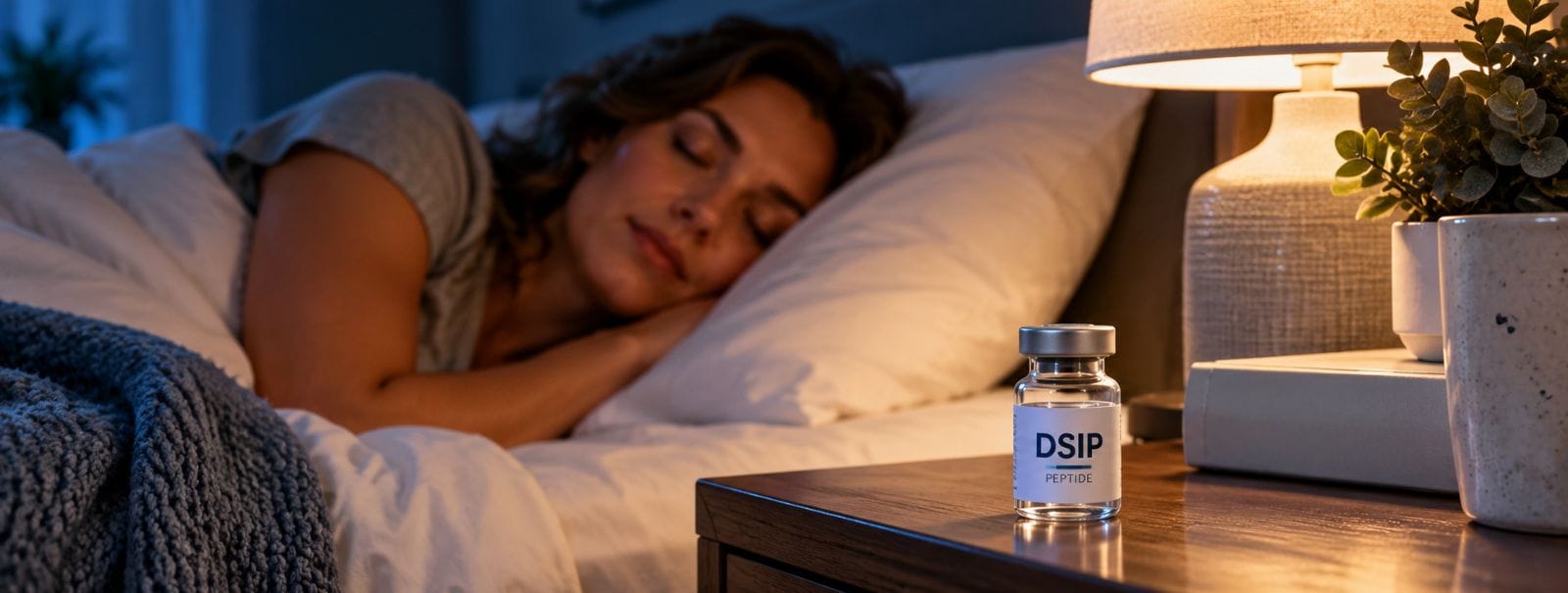
You drag through the afternoon, nearly fall asleep during dinner and promise to go to bed early.
Then your head hits the pillow, and your brain clocks in for the night shift.
Suddenly, it reviews tomorrow’s schedule, something embarrassing you said in 2007 and whether you locked the back door.
I can attest to being that person—and I am excited to start evaluating DSIP for myself.
“Tired but wired” is real. You can be exhausted while the systems controlling sleep timing, arousal and stress send the wrong signals. Peptides work with your biology, not against it. But biology is complicated and individual, so responses vary.
DSIP stands for delta sleep-inducing peptide. It is a small chain of nine amino acids first identified during sleep research in the 1970s and associated with delta-wave, or slow-wave, sleep.
DSIP is new to Recharge’s lineup, but it did not appear last Tuesday. Researchers have studied this nine-amino-acid troublemaker for decades.
It has been studied in connection with sleep regulation, stress and circadian patterns. It has not been proven to work consistently for insomnia, and it is not an FDA-approved insomnia medication.
Your circadian rhythm is the body’s approximately 24-hour timing system. Light, temperature, hormones, meals, activity and schedule help set it. Unlike this timing, sleep pressure builds while you are awake—so exhaustion and internal-clock alertness can coexist.
Think orchestra, not switch. If half the instruments are on the wrong page, adding more melatonin does not guarantee a beautiful performance.
In a study of 12 healthy volunteers monitored for 24 hours, circulating DSIP-like activity followed a daily pattern and correlated closely with body temperature. It did not rise before or during slow-wave sleep as expected; levels were lower during REM and somewhat lower during slow-wave sleep than during wakefulness. DSIP appears connected to circadian biology, but this study does not make it a master reset switch. (1994 human circadian study)
Sedation, natural sleep, normal sleep stages and waking refreshed are not the same. Anyone who has felt like a tranquilized rhinoceros the next morning knows eight unconscious hours are not automatically eight restorative hours. Researchers have investigated DSIP’s role in sleep regulation, but it should not be presented as working like Ambien, benzodiazepines, melatonin or another established treatment.
Because DSIP is newer at Recharge, I looked carefully at what participants in published human research experienced. The findings are interesting—but mixed.
In a controlled 1981 study, six middle-aged people with chronically disturbed sleep received intravenous synthetic DSIP. Researchers reported longer, higher-quality sleep, fewer interruptions, slightly more REM sleep and no daytime sedation or other reported side effects. The first hour showed slight arousal; sleep-promoting effects appeared in the second and seemed to last up to six hours. (1981 controlled study)
Encouraging? Yes. Conclusive? No. Six patients is six patients—not six thousand.
A 1992 double-blind study was less impressive. Sixteen people with chronic insomnia spent five laboratory nights: one adjustment, one baseline and three treatment nights. Half received intravenous DSIP and half glucose placebo; researchers used polysomnography and participant reports.
The DSIP group showed higher objective sleep efficiency, shorter sleep latency and improvement in one measure of tiredness. However, the statistically significant effects were weak; some apparent difference may have come from an incidental change in the placebo group, and overall subjective sleep quality did not improve significantly. The researchers concluded that short-term DSIP was unlikely to offer major therapeutic benefit for chronic insomnia. (1992 double-blind study)
This is why I reject both internet extremes: DSIP will neither fix everything and fold your laundry nor become worthless because one study was imperfect.
The useful truth is quieter: some objective measures improved, subjective sleep quality did not consistently improve, and the studies were tiny. DSIP is worth evaluating carefully—not a miracle and not nonsense. Old intravenous studies also cannot predict responses to today’s formulations, doses or routes.
People ask about DSIP hoping to fall asleep more easily, wake less, feel restored or avoid grogginess. These are goals, not promises. Results may be significant, subtle or absent, and evidence does not show that DSIP reliably increases deep sleep.
Recharge may consider an individualized combination of DSIP, Semax and Selank. The stack is not a proven sleep treatment; the clinical thinking is to address different parts of the day-and-night experience:
Semax and Selank are not new at Recharge. Patients often describe feeling calmer, clearer or more focused, with less mental noise. These are observations, not guarantees: some notice a lot, some a little and some not enough to continue.
A study of 52 healthy participants found resting-state functional-connectivity changes after Semax or Selank administration involving regions associated with anxiety regulation and executive function. Brain-imaging changes are interesting, but they do not prove every patient will feel or sleep better. (Semax and Selank functional-connectivity study)
Read more in Focus, Calm, and Clarity: The Peptides I Use When My Brain Needs to Perform.
A stack is a purposeful combination—not everything forever. It is not a buffet; more ingredients do not guarantee more results.
After evaluation, someone might use one peptide, Semax with Selank, the complete combination—or none. We adjust to the response and stop what does not help.
Sometimes the problem is not a missing peptide. Sleep apnea, thyroid or hormone changes, mental health, restless legs, iron deficiency, stimulants, alcohol, medications, pain and habits can interfere.
If you snore like a chainsaw, stop breathing and wake with headaches, I do not want to cover that up with a peptide. I want to know whether you have sleep apnea. Symptoms such as “tired but wired,” frequent waking, brain fog or schedule disruption may start a consultation, but they do not automatically make someone a candidate.
If a website will sell an injectable peptide to anyone with a credit card and no medical evaluation, that is not convenience. It is a red flag.
At Recharge, peptides are considered after medical evaluation and, when prescribed, sourced through vetted licensed compounding pharmacies—not anonymous “research product” websites.
Compounded medications are not FDA-approved or reviewed for safety, effectiveness or quality before marketing. Evidence and long-term safety data may be limited. (FDA information)
DSIP side effects are not well characterized because studies are small. Few were reported, but that does not establish safety. Unexpected reactions are possible, and injections add risks such as pain, redness, contamination or infection.
No. It is studied for possible relationships to sleep and circadian regulation—not a traditional sedative, FDA-approved insomnia drug or guaranteed treatment.
One tiny study reported no daytime sedation, but response, dose, timing and other medications matter.
One intravenous study detected effects in the second hour; another found weak or inconsistent changes over several treatments. There is no universal timeline across formulations and routes.
They are not established insomnia treatments. The rationale is possible nighttime support from DSIP, daytime calm from Selank and mental performance from Semax. Medical evaluation determines appropriateness.
DSIP appears connected to circadian biology, but is not a proven circadian reset or deep-sleep enhancer. Light, schedule, hormones, medications and health still matter.
Final Thought
Peptides work with your biology, not against it. But biology is not a vending machine. You do not insert DSIP, press “sleep” and receive eight perfect hours.
The goal is to learn why your body sends the wrong signals, decide whether a peptide fits and watch your response. DSIP is new to Recharge, and its biology is worth exploring—honestly, because studies are small, findings mixed and results variable.
That is not a weakness. That is what responsible medicine sounds like.
To discuss an individualized peptide plan, schedule a consultation in Ocala, Lady Lake/The Villages or Clermont, Call us at 352-512-9996, or through Florida telehealth. Prescribed treatments use vetted licensed compounding pharmacies and remain subject to applicable law and clinical appropriateness.
In the next article, I am moving from the brain to the appetite. We will discuss compounded semaglutide and tirzepatide orally disintegrating tablets—what an ODT is, why some patients prefer it and why “no needle” does not mean “no medical oversight.”


Monday: 8:00 am - 6:00 pm
Tuesday - Wednesday: 8:00 am - 5:30 pm
Thursday: 8:30 am - 6:30 pm
Friday: 8:00 am - 6:00 pm
Saturday: 7:45 am - 1:00 pm
After-hours appointments can be made.
Walk-ins are welcome.
Monday - Friday: 8:30 am - 5:30 pm
Walk-ins are welcome.
Monday - Friday: 8:30 am - 5:30 pm
Walk-ins are welcome.
Monday - Friday: 8:30 am-5:30 pm
Walk-ins are welcome.
Monday: 8:30 am - 5:30 pm
Tuesday: Telehealth Appts. Only
Wednesday - Friday: 8:30 am - 5:30 pm
Saturday & Sunday: Closed
Walk-ins Welcome
Monday - Wednesday 8 am - 6 pm
Thursday 8 am - 6:30 pm
Friday 8 am - 6 pm
Saturday 7:45 am - 1 pm
👻BOTOX & BOOs👻
OCTOBER 23
8:30 AM - 5:30 PM
3175 Citrus Tower Blvd, Bldg 3,
Ste B, Clermont, FL 34711
Celebrate Halloween at Recharge
Clinic in Clermont! Grab your friends,
enjoy drinks, and SCARY-GOOD specials!
IN-PERSON SPECIALS ONLY
- PLEASE RSVP BELOW
Recharge Rewards is our way of saying thank you to patients who trust us with their care. The more you visit, the more you earn. Check out how our program works: Click Here
Mondays - NAD+ Shot
Wednesdays - KETO Shot
Fridays - Fitness Freak Shot
SE Ocala 17th St:
Wednesdays – 3 pm - 5 pm
NW Ocala N HWY 27:
Mondays – 2 pm - 5 pm
SW Ocala SW HWY 200:
Tuesdays & Fridays – 2pm - 5 pm
Lady Lake:
Thursdays – 11 am - 3 pm
Clermont:
Mondays, Wednesdays, Thursdays, & Fridays – 2pm - 5pm
47 SW 17th St. , Ocala, FL 34471:
Wednesdays 11 am - 2 pm
3175 Citrus Tower Blvd, Bldg 3, Suite B, Clermont, Fl 37411:
Mondays, Wednesdays, Thursdays, & Fridays 11 am - 2 pm
CLERMONT CLINIC HOURS
Monday - 8:30 AM - 5:30 PM
Tuesday - Telehealth Appts. Only
Wedensday - 8:30 AM - 5:30 PM
Thursday - 8:30 AM - 5:30 PM
Friday - 8:30 AM - 5:30 PM
Walk-ins Welcome
3175 Citrus Tower Blvd, Bldg 3, Ste B, Clermont, FL 34711