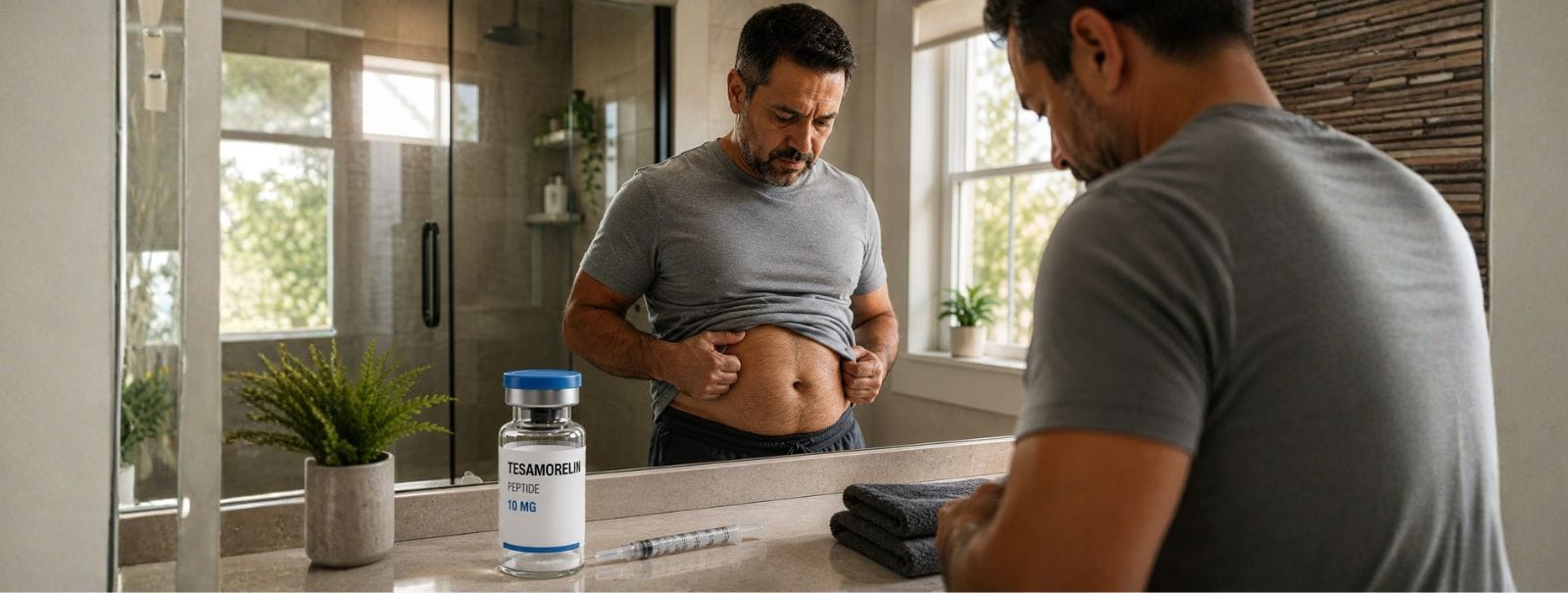

A lot of patients come in frustrated by abdominal fat. Not just “I want to look better in jeans” fat, but the deeper, firmer, more metabolically active abdominal fat that sits around the organs. That type of fat is called visceral adipose tissue, and it behaves very differently from the soft fat under the skin.
Visceral fat is more inflammatory. It is more hormonally active. It is more closely tied to insulin resistance, cardiometabolic risk, fatty liver patterns, and that stubborn “hard belly” that does not always respond the way people expect.
Tesamorelin is a peptide that deserves a careful conversation in that context.
Tesamorelin is a growth hormone-releasing hormone analog. In plain English, it signals the pituitary gland to release more of your own growth hormone, which then increases IGF-1 signaling. It is not the same as injecting growth hormone. It is upstream of that process. The FDA-approved medication EGRIFTA WR, which contains tesamorelin, is indicated to reduce excess abdominal fat in adults with HIV-associated lipodystrophy. The prescribing information also clearly states that it is not for weight loss management.
That distinction matters.
Tesamorelin is not a vanity shot. It is not a GLP-1. It is not a “melt fat while you keep doing everything else wrong” medication. It works through growth hormone biology, and that means it requires respect, screening, labs, and follow-up.
In clinical research involving HIV-infected patients with abdominal fat accumulation, tesamorelin has been shown to reduce visceral adipose tissue. In one randomized clinical trial published in JAMA, tesamorelin significantly reduced visceral fat and modestly reduced liver fat over six months compared with placebo.
That is why this peptide gets attention beyond its FDA-approved indication. Patients and clinicians are interested in the possibility of improving body composition, visceral fat burden, and metabolic patterns. But off-label interest does not remove the need for caution. Growth hormone and IGF-1 pathways are powerful. Powerful tools can help the right patient and hurt the wrong one.
Tesamorelin may be worth discussing for patients who have signs of visceral adiposity and metabolic dysfunction, especially when lifestyle alone is not giving adequate results. Examples may include:
The key phrase is medically guided. Tesamorelin affects growth hormone and IGF-1 signaling. That means we need to know what is going on with your glucose, insulin sensitivity, cancer history, fluid retention risk, medications, and overall health.
Tesamorelin is not appropriate for everyone. Based on prescribing information for EGRIFTA WR, it is contraindicated in patients with disruption of the hypothalamic-pituitary axis, active malignancy, known hypersensitivity to tesamorelin or its excipients, and pregnancy. The label also warns about increased IGF-1 levels, fluid retention, glucose intolerance or diabetes, hypersensitivity reactions, injection site reactions, and increased mortality risk in acute critical illness related to certain growth hormone contexts.
In practical clinic language, I would be very cautious or say no in patients with:
The label notes that tesamorelin increases IGF-1 and recommends monitoring IGF-1 during therapy. It also recommends glucose evaluation before and during therapy because glucose intolerance or diabetes can develop.
That is why I do not like casual peptide use. It is not that peptides are scary. It is that people treat them too casually.
Tesamorelin is a perfect example of why sourcing matters. A peptide is not just a name on a label. It has to be the correct molecule, at the correct strength, sterile if injected, stored correctly, and used in the right patient.
When someone orders a peptide from a random online site, they are trusting a stranger with their endocrine system and overall health safety. That is a big leap of faith.
Here is what you do not know with an unregulated source:
FDA has warned that compounded drugs are not FDA-approved and that poor-quality compounded drugs can cause serious injury or death if contaminated or incorrectly made. That is why legitimate medical sourcing, pharmacy accountability, and physician oversight matter so much.
At Recharge, we do not approach peptides like a trend. We approach them like medical tools. When appropriate, we source through regulated, licensed pharmacy channels and monitor patients clinically. The difference between that and an online mystery vial is not a small detail. That is the whole point.
Tesamorelin may be a valuable option for the right patient, especially when visceral fat and metabolic health are part of the concern. But it is not for casual weight loss, not for pregnancy, not for active cancer, and not for people who do not want labs.
Used correctly, tesamorelin is a medical conversation. Used recklessly, it is endocrine gambling.
And I do not want my patients gambling with their hormones.
Scheduling with Recharge Clinic is simple.
You can call 352-512-9996 or book an appointment online through the Recharge Clinic website. Recharge also welcomes walk-ins at select locations, depending on the service and availability.
When you schedule, let the team know you are interested in learning more about peptides. From there, we can help guide you through the next steps, review your labs, and discuss what may be appropriate for you.
Start here: KPV Peptide — Calming the Fire of Inflammation Without Playing Internet Roulette
Wolverine, BPC-157, and KLOW — Recovery Peptides Are Not Magic, and They Are Definitely Not DIY
Whether you're exploring peptides for inflammation, metabolic health, or recovery, understanding the science, the risks, and the importance of proper medical supervision is essential. Be sure to follow the full series as Dr. Tieche breaks down what these therapies can—and cannot—do.
No. Tesamorelin is not a general weight-loss shot, and I do not want patients thinking of it that way. Tesamorelin is a growth hormone-releasing hormone analog that signals the body to release more of its own growth hormone, which then affects IGF-1. The FDA-approved tesamorelin product, EGRIFTA WR, is used to reduce excess abdominal fat in adults with HIV-associated lipodystrophy, and its labeling states that it is not for weight loss management.
Tesamorelin may be worth discussing for patients with central abdominal fat that appears more visceral, especially when that fat is connected with metabolic concerns like insulin resistance, poor body composition, or fatty liver tendencies. It is best suited for patients already doing the fundamentals: resistance training, protein intake, sleep, blood sugar control, stress management, and alcohol moderation. This is not a “do nothing and lose fat” option. It is a medical tool that requires evaluation and monitoring.
Because tesamorelin affects growth hormone and IGF-1 signaling, monitoring matters. Patients may need baseline and follow-up evaluation of IGF-1, fasting glucose, A1C, insulin resistance markers, and overall metabolic health. The prescribing information for EGRIFTA WR warns that it can increase IGF-1, may cause fluid retention, and can contribute to glucose intolerance or diabetes. That is why I do not like casual use. If we are going to influence hormone pathways, we need to measure and monitor.
Tesamorelin is not appropriate for patients with active cancer, pregnancy, known hypersensitivity to tesamorelin, or disruption of the hypothalamic-pituitary axis. I would also be cautious in patients with a history of cancer, uncontrolled diabetes, worsening diabetic eye disease, significant swelling, carpal tunnel symptoms, or unstable medical conditions. The prescribing information specifically warns about active malignancy, elevated IGF-1, fluid retention, glucose intolerance, hypersensitivity reactions, injection site reactions, and critical illness concerns.
This blog is for educational purposes only and is not intended to diagnose, treat, cure, or prevent any disease. Tesamorelin is not appropriate for everyone and should only be used under the supervision of a qualified healthcare provider. Treatment decisions should be based on an individual's medical history, laboratory evaluation, current medications, and overall health. Never use peptide therapies without proper medical guidance or purchase them from unregulated online sources.
Want to learn more about peptide therapy?
Join us for our FREE Wellness Talk: Recovery Peptides: Healing Beyond Traditional Medicine
📅 Wednesday, July 8, 2026
🕕 6:00 PM – 7:00 PM
📍 Recharge Clinic
47 SW 17th St., Ocala, FL 34471
Can't make it in person? Join us live on Zoom!
👉 Reserve your spot: https://lp.constantcontactpages.com/sl/ALdwL3u/WTRecoveryPeptides


Monday: 8:00 am - 6:00 pm
Tuesday - Wednesday: 8:00 am - 5:30 pm
Thursday: 8:30 am - 6:30 pm
Friday: 8:00 am - 6:00 pm
Saturday: 7:45 am - 1:00 pm
After-hours appointments can be made.
Walk-ins are welcome.
Monday - Friday: 8:30 am - 5:30 pm
Walk-ins are welcome.
Monday - Friday: 8:30 am - 5:30 pm
Walk-ins are welcome.
Monday - Friday: 8:30 am-5:30 pm
Walk-ins are welcome.
Monday: 8:30 am - 5:30 pm
Tuesday: Telehealth Appts. Only
Wednesday - Friday: 8:30 am - 5:30 pm
Saturday & Sunday: Closed
Walk-ins Welcome
Monday - Wednesday 8 am - 6 pm
Thursday 8 am - 6:30 pm
Friday 8 am - 6 pm
Saturday 7:45 am - 1 pm
👻BOTOX & BOOs👻
OCTOBER 23
8:30 AM - 5:30 PM
3175 Citrus Tower Blvd, Bldg 3,
Ste B, Clermont, FL 34711
Celebrate Halloween at Recharge
Clinic in Clermont! Grab your friends,
enjoy drinks, and SCARY-GOOD specials!
IN-PERSON SPECIALS ONLY
- PLEASE RSVP BELOW
Recharge Rewards is our way of saying thank you to patients who trust us with their care. The more you visit, the more you earn. Check out how our program works: Click Here
Mondays - NAD+ Shot
Wednesdays - KETO Shot
Fridays - Fitness Freak Shot
SE Ocala 17th St:
Wednesdays – 3 pm - 5 pm
NW Ocala N HWY 27:
Mondays – 2 pm - 5 pm
SW Ocala SW HWY 200:
Tuesdays & Fridays – 2pm - 5 pm
Lady Lake:
Thursdays – 11 am - 3 pm
Clermont:
Mondays, Wednesdays, Thursdays, & Fridays – 2pm - 5pm
47 SW 17th St. , Ocala, FL 34471:
Wednesdays 11 am - 2 pm
3175 Citrus Tower Blvd, Bldg 3, Suite B, Clermont, Fl 37411:
Mondays, Wednesdays, Thursdays, & Fridays 11 am - 2 pm
CLERMONT CLINIC HOURS
Monday - 8:30 AM - 5:30 PM
Tuesday - Telehealth Appts. Only
Wedensday - 8:30 AM - 5:30 PM
Thursday - 8:30 AM - 5:30 PM
Friday - 8:30 AM - 5:30 PM
Walk-ins Welcome
3175 Citrus Tower Blvd, Bldg 3, Ste B, Clermont, FL 34711