By Cynthia Tieche, CEO and Co-Founder of Recharge Clinic
Part 1 of my pituitary tumor story
I was offended.
That probably sounds like a strange reaction to finding out you have a brain tumor, but it’s the truth! I take care of my body. I pay attention to what I eat, what I put in it, how much I exercise, and how my choices today will affect me years from now. And my body decided to grow a tumor? In my HEAD?
I was angry and confused because I felt healthy! I was working, traveling, exercising, taking care of my family, and doing everything I normally did. My husband, Dr. Steve Tieche, found my pituitary adenoma, a tumor of the gland at the base of the brain, because he and our team at Recharge Clinic kept investigating. And one of the things that got that investigation started was something I never would have connected to a tumor: my greasy skin.
Looking back, changes had been happening for about five years. At the time, though, they seemed like separate problems. My shoes stopped fitting comfortably, but I’ve had a bunion since I was a kid, and it had gotten worse. Of course my shoes hurt! I had carpal tunnel surgery on both hands, but I spent plenty of time on a computer. That made sense, too.
Then there were my rings. They stopped fitting, which I thought had something to do with the carpal tunnel. When they still didn’t fit after surgery, I waited. After about two years, I finally had them resized. Then they stopped fitting AGAIN. That was weird.
My estrogen had also gotten very low, and my periods had stopped. We were looking into that with my gynecologist and additional testing. But I never walked into an appointment and laid out all these changes together. They happened gradually, over years, and I had a reasonable explanation for almost every one.
Then there was my skin. Why in the world was it so oily? That bothered me enough to keep asking. I had no idea that my skin, my hands, my feet, and other changes might all belong in the same conversation.
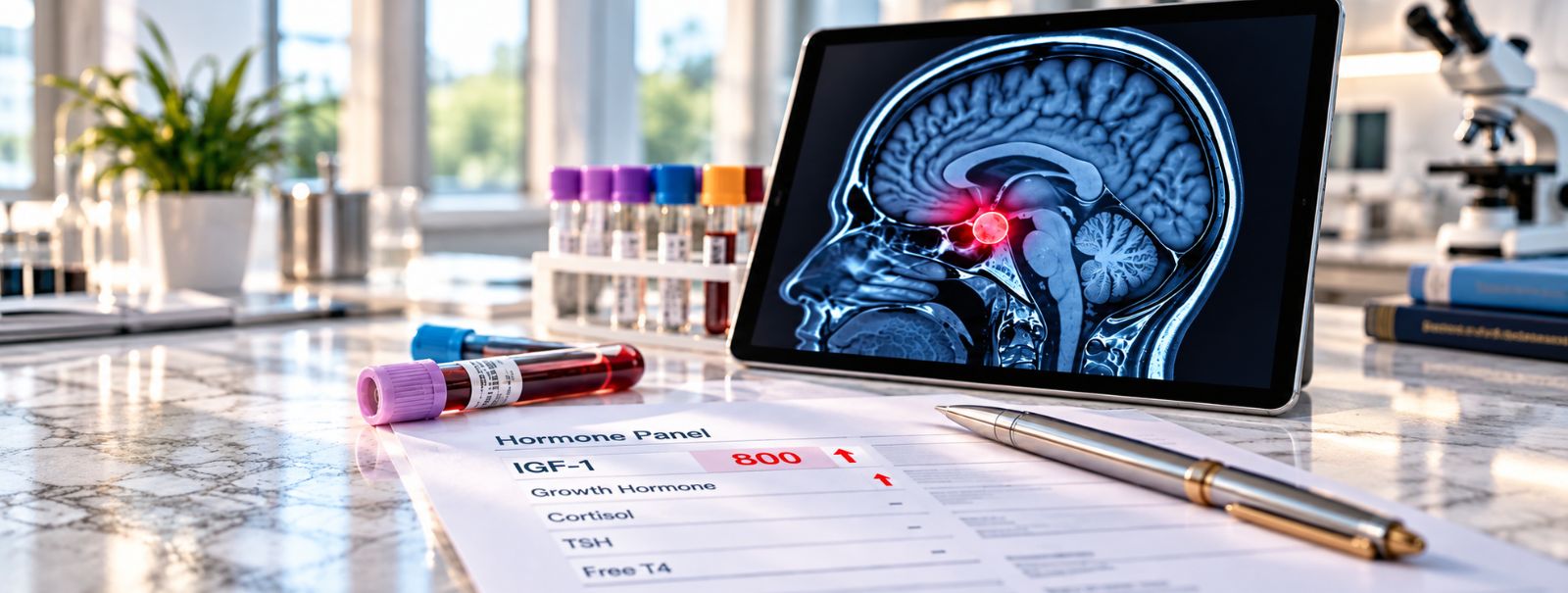
Steve and one of our nurse practitioners at Recharge were discussing my symptoms and decided to investigate my hormones further. One of the tests they ordered was IGF-1. Mine came back around 800.
Steve was shocked. His first thought was that the result might be wrong, so we repeated it a few weeks later. It was still high. He checked my growth hormone and arranged a glucose suppression test, which looks at whether growth hormone falls appropriately after a glucose drink. Mine didn’t.
I knew he was investigating something, but I didn’t want a running list of every frightening possibility while he was figuring it out. I also knew myself well enough to stay off Google. I told him I trusted him and to do what he needed to do to figure this out.
Eventually, he explained that the results pointed toward a pituitary tumor producing too much growth hormone. We needed an MRI to find out. I didn’t have headaches or vision problems, and I felt healthy. It was hard to put those feelings together with what he was telling me, but the bloodwork needed an answer.
Our Recharge team got my MRI scheduled for the next day. I am still grateful for how quickly they moved things along. I prayed, tried to take it one day at a time, and continued to stay out of the internet rabbit holes.
After the MRI, I kept texting Steve to ask whether he had the results. He would answer, “Not yet, Cynthia, I will let you know.” Later that afternoon, I texted again. He read it but didn’t answer. Crap. So I called him.
Bella was with me. She’s in medical school and had already learned about pituitary tumors. I was so glad she was home during all this testing. Having her help explain things made a difference.
When Steve called shortly afterward, he sounded different. “Well, you do have a pituitary adenoma and it is 1.2 centimeters.” My first question was essentially, okay, what do we do?
He explained that the tumor’s position was favorable and that it wasn’t pressing on the nerves involved in my vision. Obviously, he wished I didn’t have a tumor at all. But from his experience providing anesthesia for these surgeries, he felt encouraged by what we knew.
Then he started researching surgeons. That is Steve. Find the problem, find the right person, figure out the next step. I needed that.
My tumor was producing excess growth hormone, and that overproduction had caused acromegaly. My understanding is that a spontaneous genetic change in pituitary cells allowed the tumor to develop. “Genetic” doesn’t automatically mean inherited; changes can happen during a person’s lifetime. My body had developed a tumor that was making growth hormone on its own.
Recharge’s role in this story was finding it. Steve and our team recognized abnormal results and kept investigating until we had an answer. Growth hormone has important jobs in the body, but too much over time can affect bones and soft tissues. Separately, when growth hormone is prescribed for a diagnosed medical need, it should be managed by a reputable, licensed medical provider who monitors the treatment and avoids excess. More is not better!
Once we knew what was happening, we started looking backward at the rings, the shoes, and the carpal tunnel. Then the surgeon asked whether my teeth had moved. Actually, YES! I had gone back into Invisalign after already having it years earlier. I thought I had done something wrong. Now we were discussing changes in my jaw.
I noticed changes in my cheekbones, too. Later, after surgery, I heard my voice in an old video and realized how different it sounded. I used to teach fitness classes and did plenty of yelling, so I’d had an explanation for that one, too!
It’s much easier to see a pattern once someone tells you what you’re looking at. While I was living it, I was dealing with one thing at a time.
Please don’t read this and decide that greasy skin means you have a brain tumor. What I want you to understand is how easily I explained away changes in my own body. I pay attention to my health, run a medical clinic, and am married to a physician. And I still didn’t put these things together myself.
I’m grateful Steve was paying attention and that our nurse practitioner joined that conversation. When the first result seemed wrong, they repeated it and kept going. Ordering the test mattered. Following through on the result mattered just as much.
We found my tumor before it was affecting my vision, while my surgeon felt its position was favorable for removal. I can’t know what would have happened if we had waited longer, and I am thankful we didn’t have to find out.
Tell your provider what is changing, even if you think you already know why. Mention the things you’ve gotten used to living with. Follow up when a result is abnormal. You don’t have to connect all the dots yourself.
At that point, I had a diagnosis, a plan, and people around me who felt confident. I was still about to find out how scared I could feel.
In Part 2, I’ll share why I ended up shaking in the grocery store, how I learned to ask for prayer, and the women I believe God sent at exactly the right moments—especially the day before surgery.
It’s a tumor of the pituitary gland, which sits at the base of the brain. These tumors are usually noncancerous. Mine produced excess growth hormone.
My acromegaly symptoms came from excess growth hormone. Vision problems can happen when a pituitary tumor presses on nearby visual structures. Mine wasn’t pressing on those structures when Steve found it.
My clinicians ordered targeted testing. IGF-1 isn’t automatically included in routine bloodwork. Ask your provider what your tests cover and what additional testing, if any, fits your symptoms.
No. Oily skin alone doesn’t tell the whole story. Discuss the full pattern of changes with your clinician so they can decide what testing makes sense.
Yes. A primary care visit is a place to talk through your symptoms, your history, and what should happen next.
If something has changed, bring it up. You don’t need to arrive with a diagnosis or wait until you feel terrible. For primary care in Ocala, Lady Lake near The Villages, or Clermont, call Recharge Clinic at 352-512-9996 or visit our primary care page. Start by telling us what’s going on.
References


Monday: 8:00 am - 6:00 pm
Tuesday - Wednesday: 8:00 am - 5:30 pm
Thursday: 8:30 am - 6:30 pm
Friday: 8:00 am - 6:00 pm
Saturday: 7:45 am - 1:00 pm
After-hours appointments can be made.
Walk-ins are welcome.
Monday - Friday: 8:30 am - 5:30 pm
Walk-ins are welcome.
Monday - Friday: 8:30 am - 5:30 pm
Walk-ins are welcome.
Monday - Friday: 8:30 am-5:30 pm
Walk-ins are welcome.
Monday: 8:30 am - 5:30 pm
Tuesday: Telehealth Appts. Only
Wednesday - Friday: 8:30 am - 5:30 pm
Saturday & Sunday: Closed
Walk-ins Welcome
Monday - Wednesday 8 am - 6 pm
Thursday 8 am - 6:30 pm
Friday 8 am - 6 pm
Saturday 7:45 am - 1 pm
👻BOTOX & BOOs👻
OCTOBER 23
8:30 AM - 5:30 PM
3175 Citrus Tower Blvd, Bldg 3,
Ste B, Clermont, FL 34711
Celebrate Halloween at Recharge
Clinic in Clermont! Grab your friends,
enjoy drinks, and SCARY-GOOD specials!
IN-PERSON SPECIALS ONLY
- PLEASE RSVP BELOW
Recharge Rewards is our way of saying thank you to patients who trust us with their care. The more you visit, the more you earn. Check out how our program works: Click Here
Mondays - NAD+ Shot
Wednesdays - KETO Shot
Fridays - Fitness Freak Shot
SE Ocala 17th St:
Wednesdays – 3 pm - 5 pm
NW Ocala N HWY 27:
Mondays – 2 pm - 5 pm
SW Ocala SW HWY 200:
Tuesdays & Fridays – 2pm - 5 pm
Lady Lake:
Thursdays – 11 am - 3 pm
Clermont:
Mondays, Wednesdays, Thursdays, & Fridays – 2pm - 5pm
47 SW 17th St. , Ocala, FL 34471:
Wednesdays 11 am - 2 pm
3175 Citrus Tower Blvd, Bldg 3, Suite B, Clermont, Fl 37411:
Mondays, Wednesdays, Thursdays, & Fridays 11 am - 2 pm
CLERMONT CLINIC HOURS
Monday - 8:30 AM - 5:30 PM
Tuesday - Telehealth Appts. Only
Wedensday - 8:30 AM - 5:30 PM
Thursday - 8:30 AM - 5:30 PM
Friday - 8:30 AM - 5:30 PM
Walk-ins Welcome
3175 Citrus Tower Blvd, Bldg 3, Ste B, Clermont, FL 34711